
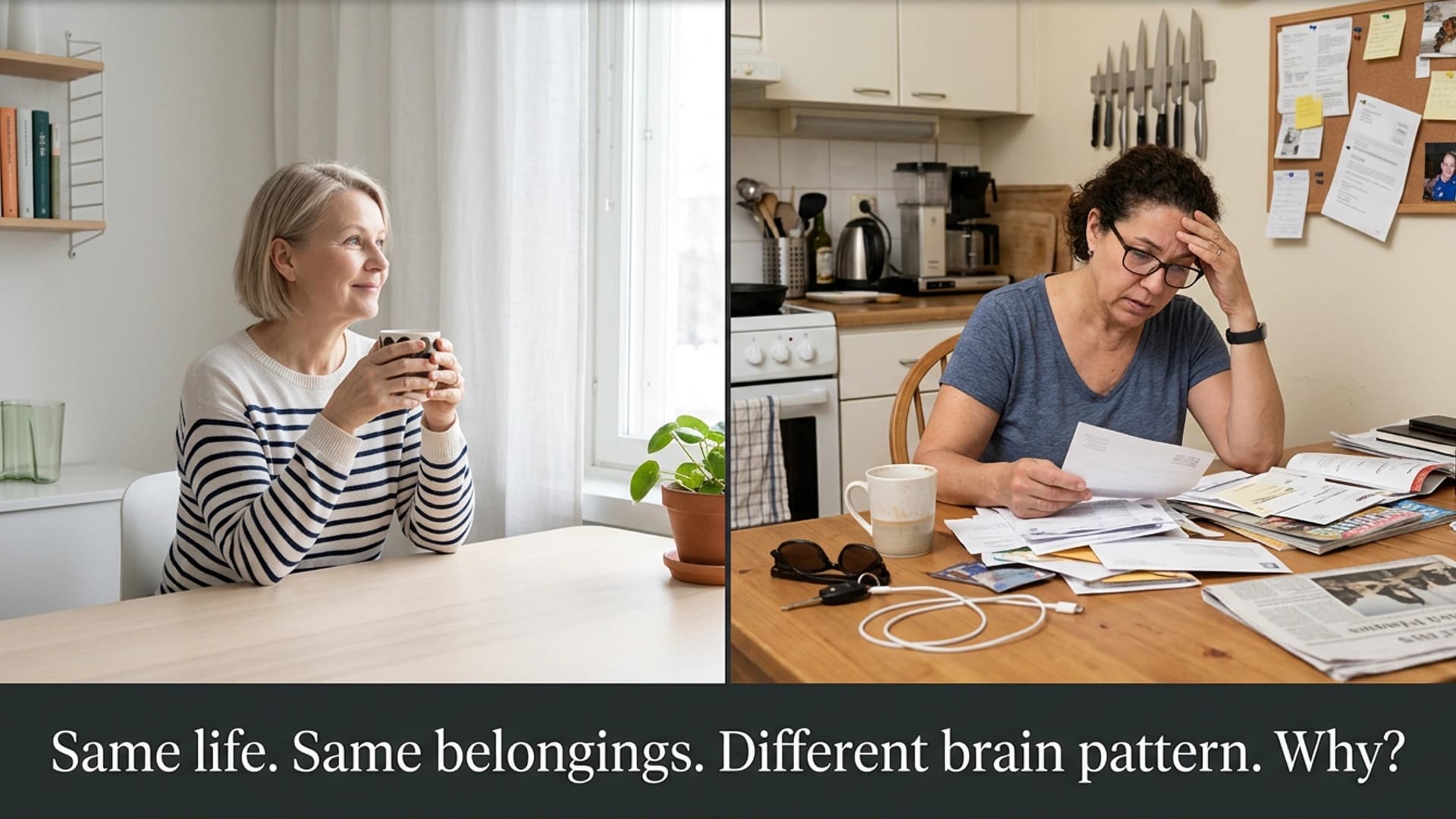
147,000 Women Broke Free From Chronic Clutter In 30 Days Using This Finnish "Brain Reset" Method
I know what an organized home looks like.
I grew up in one. My mother ran a tight ship, everything had a place, nothing stayed out, the kitchen counter was cleared before bed every single night. I watched her do it my entire childhood.
So why, at 54, can I not do the same thing?
It's not for lack of trying. Every January for the past twelve years I've had the same conversation with myself. This is the year. This time I'll actually keep it up. I'd spend a whole weekend reorganizing, clearing surfaces, sorting through drawers, filling bags for Goodwill.
The house would look wonderful.
For about two weeks.
Then life would quietly resume. Papers would settle on the counter again. The chair in the bedroom became a wardrobe again. The pile by the back door came back, like it had never left.
I started to think there was something wrong with me specifically. My mother never struggled with this. My neighbor's house always looks calm. What do they know that I don't?
As it turns out: it's not about knowing. It's about the brain.
The Helsinki Kitchen That Changed How I Think About Everything
My college roommate moved to Finland fifteen years ago. Last spring I finally visited her, something I'd been putting off for longer than I'd like to admit.
She and her husband live in a modest apartment outside Helsinki. Two people, long lives, decades of accumulated belongings. I expected it to feel cramped.
It didn't. It felt like exhaling.
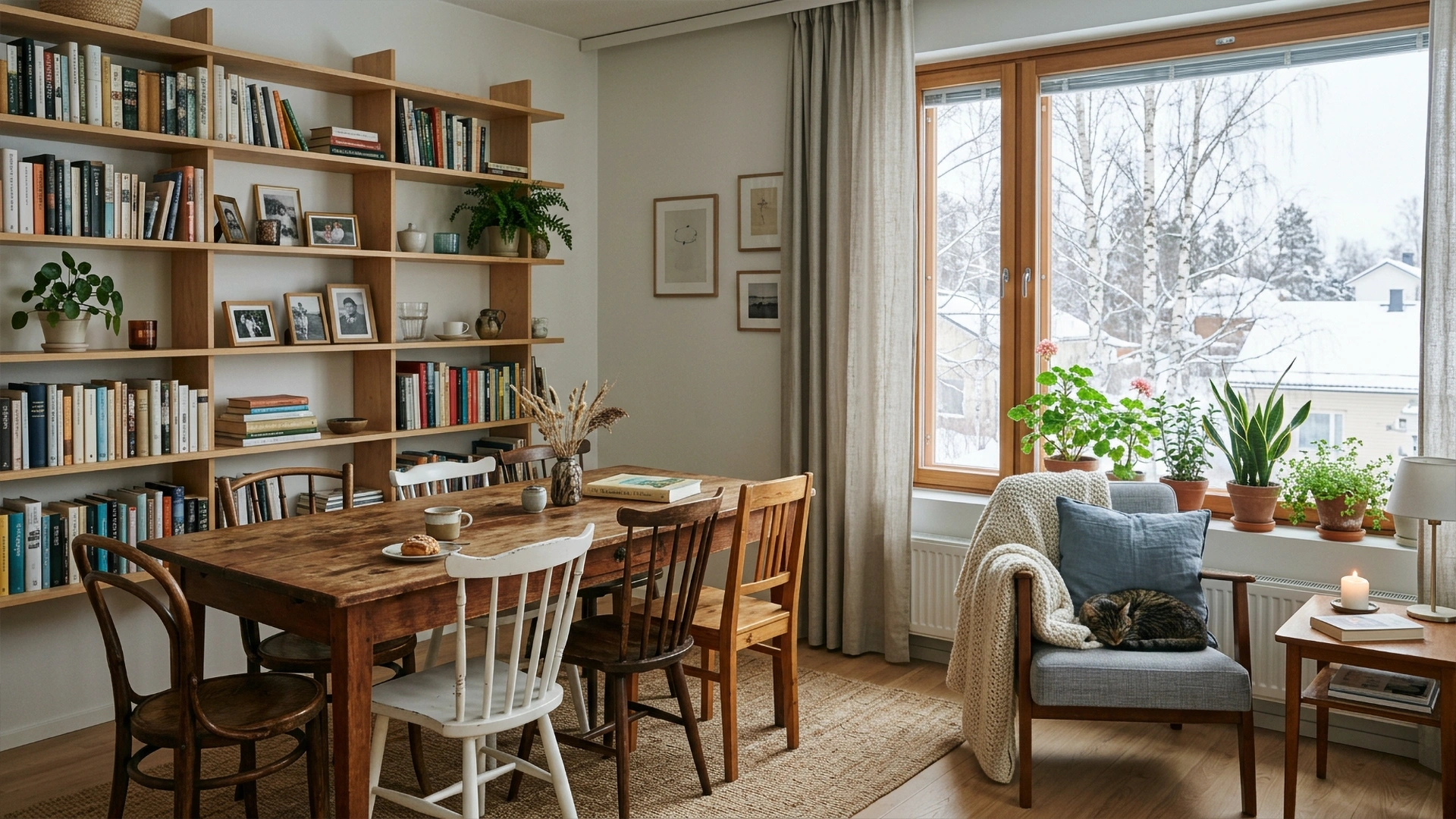
Not bare. Not sterile. There were books on the shelves, photographs on the walls, a well-loved wooden table in the kitchen with mismatched chairs. Evidence of a real life being lived.
But nothing was fighting for attention. Nothing was waiting to be dealt with. The surfaces were just... clear.
I asked her about it over coffee.
She thought about it for a moment and said something I've turned over in my mind ever since: "We don't really think about tidiness. We think about not letting the brain get tired."
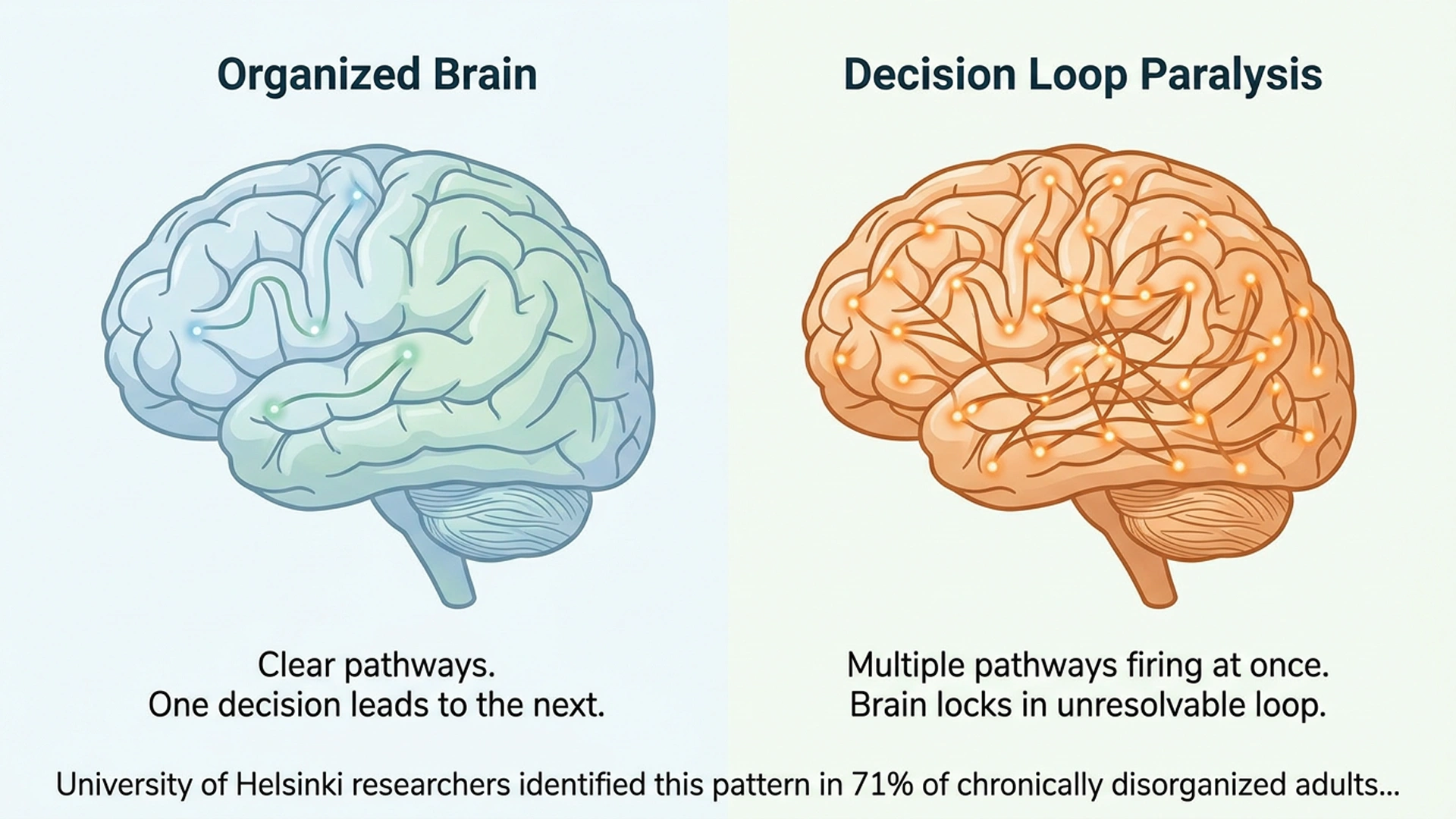
University of Helsinki Research Identified "Decision Loop Paralysis" In 71% Of Chronically Disorganized Adults
When I came home I started researching Finnish approaches to household organization.
That search eventually led me to the work of Dr. Aino Makinen, a behavioral neuroscientist at the University of Helsinki who has spent 17 years studying exactly the pattern I'd been living inside.
I connected with her team through an online seminar. What she described was the first explanation that had ever actually made sense to me.
"When we image the brains of chronically disorganized adults, we don't see laziness. We see a very specific pattern, decision loop paralysis. The brain begins to process a task, becomes overwhelmed evaluating too many options at once, and shuts down. The person walks away. The mess stays. And crucially, the loop gets a little stronger each time."
She showed brain scans side by side. An organized person looking at a cluttered surface: clean, sequential neural pathways firing one after another.
A chronically disorganized person looking at the same surface: dozens of pathways lighting up simultaneously, the brain locked in a loop it can't resolve.
"This is why experience doesn't fix it," Dr. Makinen said. "You can spend thirty years running a household and still have this pattern. Because it's not about knowledge or intention. It's a neural loop. And loops don't respond to willpower."
What does respond to it, she explained, is something the Finns have a word for: sisu.
Not motivation. Not inspiration. Quiet, consistent, daily discipline, applied in very small doses, until the new pattern becomes stronger than the old one.
Finnish researchers had spent years developing a structured method around this principle, rooted in Cognitive Behavioral Therapy. Not talk therapy. Not journaling.
Micro-interventions, exercises so small they take five minutes or less, designed specifically to interrupt the decision loop and build a new neural pathway in its place.
81% of the 147,000 participants in the University of Helsinki study reported being completely free of chronic procrastination after just 4 weeks, using only 5 to 10 minutes of daily exercises.
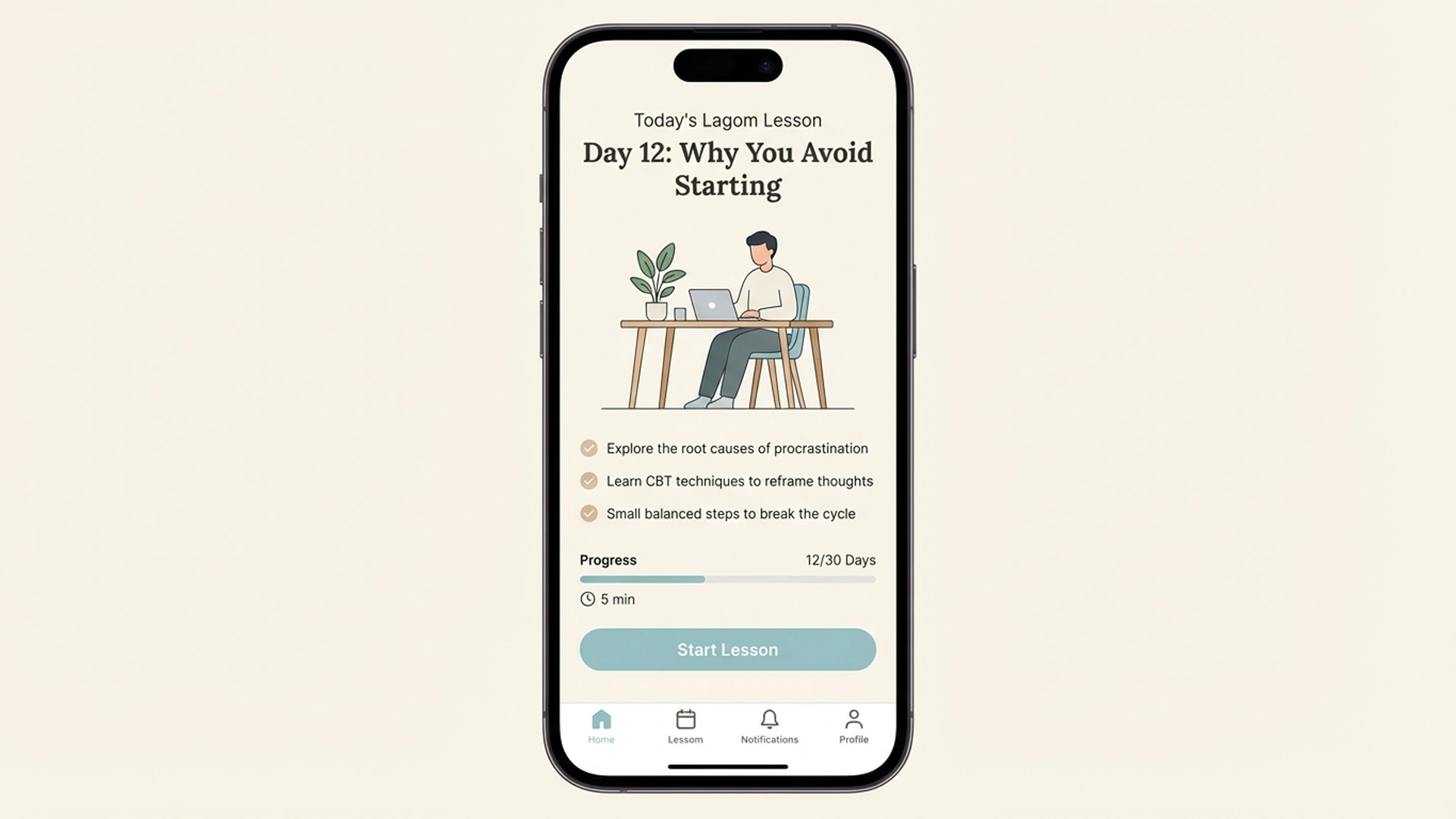
Her research team had worked with developers to turn the method into a daily app.
SteadyMinds. A short lesson and one small exercise, every morning. Five to ten minutes.
"The Finnish approach," Dr. Makinen said, "is never to confront a hard thing all at once.
Sisu is not about brute force. It is about one small thing, every day, until the new pattern is simply stronger than the old one."
I downloaded it that night.
Day One: The Smallest Task I'd Ever Been Assigned
The app asked me a few questions about when I procrastinate and what triggers it. Then it gave me my first task.
"Find three things near you right now and put them where they belong."
I almost laughed. Three things? I could see forty things from where I was sitting.
But the lesson explained the point: this wasn't about the three items. It was about teaching my brain to complete a commitment, any commitment, without first spiraling into overwhelm.
The brain needed to experience finishing. Not planning to finish. Not intending to finish. Actually finishing.
"Your brain learns from evidence," the lesson said. "Give it evidence that you complete things. Tiny evidence, repeated daily, becomes the loudest voice in the room."
I put away three things. It took ninety seconds.
I felt slightly foolish. And then, underneath that, something quieter: a small, clean sense of done.
Day 4
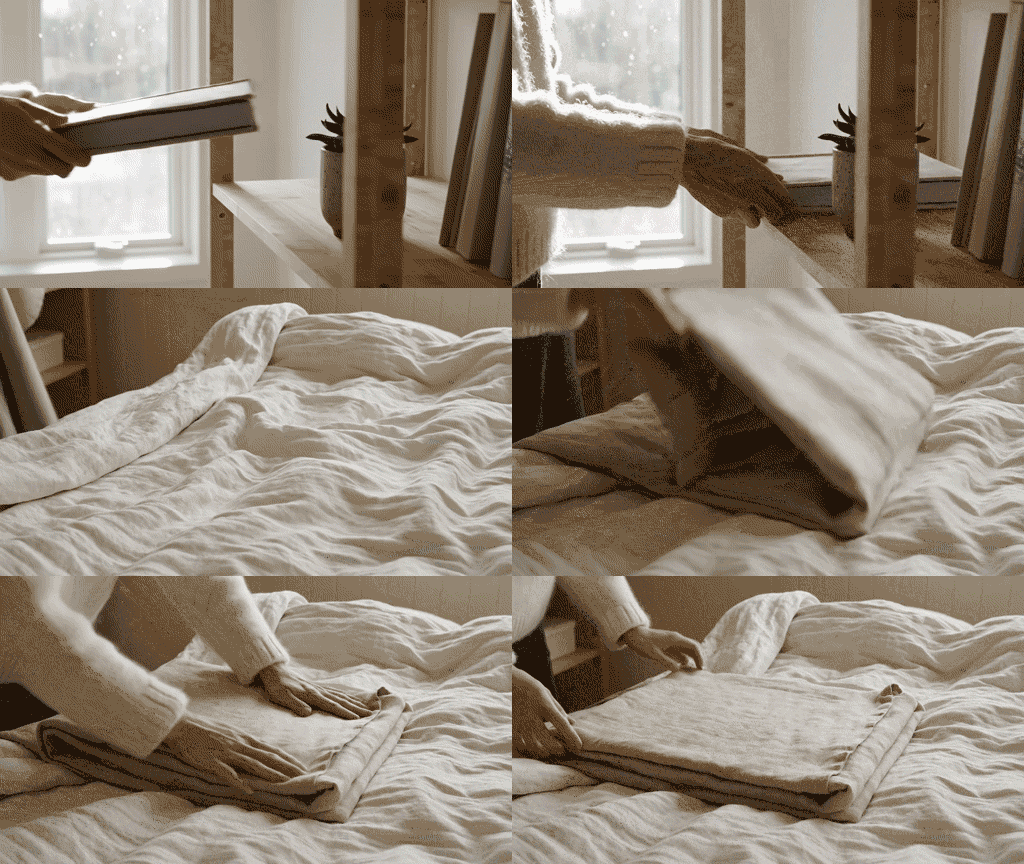
Today's lesson was about decision fatigue, why I went blank every time I stood in front of a mess, meaning to start. The exercise: pick one surface. Clear it completely. Don't sort, don't organize, just clear. I chose the kitchen table.
Eight minutes later it was bare. I made a cup of tea and sat down at it for the first time in months. I don't know why that made me want to cry a little. But it did.
By Day 7, Something Had Quietly Shifted
Every morning: one notification. One task. Never more than ten minutes.
"Sort three pieces of paper." "Hang up the coats by the door." "Clear the bathroom counter."
My house still had years of accumulated living in it. Nothing dramatic had changed.
But I stopped freezing. That particular paralysis, standing in a room, feeling the weight of everything that needed doing, then turning around and leaving, started losing its grip. I'd see something. I'd do something about it. That was new.
The streak counter in the app became something I found myself not wanting to break.
Seven days. Ten. Fourteen.
Week Three: My Daughter Called It "The Quiet House"
Week 3
My daughter came for Sunday dinner and walked in without saying anything for a moment.
Then: "Mom. What happened in here?" I told her I'd been doing a brain thing. She looked at me like I'd said something slightly odd.
But later she texted: "Whatever the brain thing is, keep doing it. The house feels different. Like you can actually breathe in it."
That text is still on my phone.
What surprised me most was how far outside the house the change reached. I finished a quilt that had been sitting in pieces in the spare room for three years. I made the dentist appointment I'd been putting off since before the pandemic. I started returning calls the same day instead of letting them sit until they felt too late to return.
None of that was in the app. The app was just changing the pattern. And apparently the pattern ran through everything.
Week Four: The Mess Simply Stopped Coming Back
I want to say something clearly, because I spent years believing the wrong thing about myself:
The clutter was never the problem.
Every organizing method I'd ever tried focused on the result, the clean surface, the sorted drawer, the labeled shelf.
But it never touched the reason the surface got cluttered in the first place. So a few weeks later, the mess was back. And I felt a little worse about myself than before.
CBT-based micro-interventions work on the cause, not the symptom.
They don't reorganize your home. They reorganize the pattern in your brain. Five minutes at a time, every day, until completion becomes the reflex instead of avoidance.
"Most people try to change years of accumulated habits in a single weekend. The brain panics and falls back on what it knows. Small daily wins teach the brain something quieter and more lasting: that finishing feels better than avoiding. That becomes the new default."
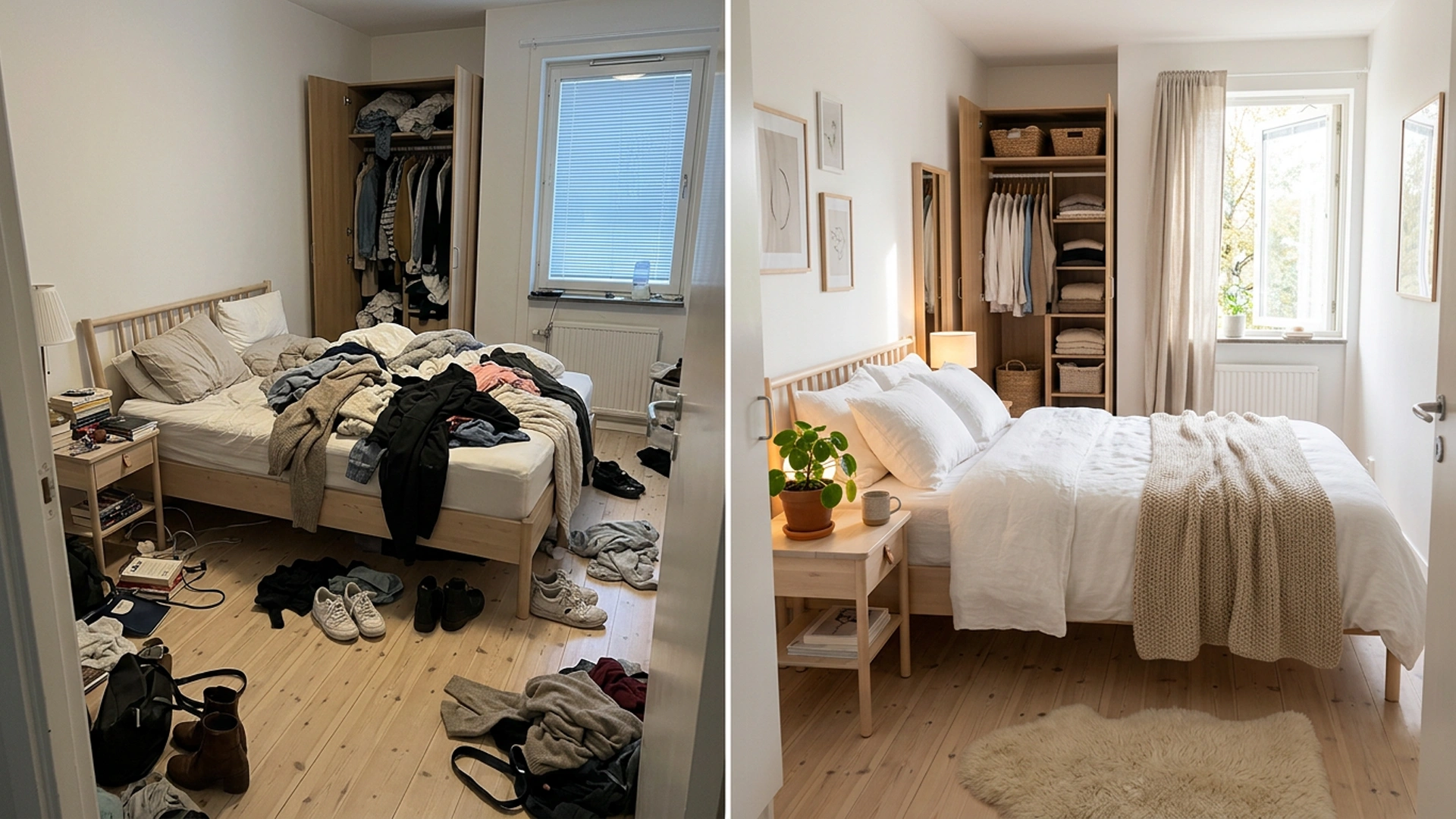
By week four, I wasn't managing my clutter anymore.
I just wasn't making it.
What I Actually Got Back
I thought I would get a tidier house. I did get that.
But what I didn't expect was the silence.
The disappearance of that low, constant hum of guilt that had followed me from room to room for years, the I really should deal with that that never quite left, even when I sat down to rest.
That's gone now.
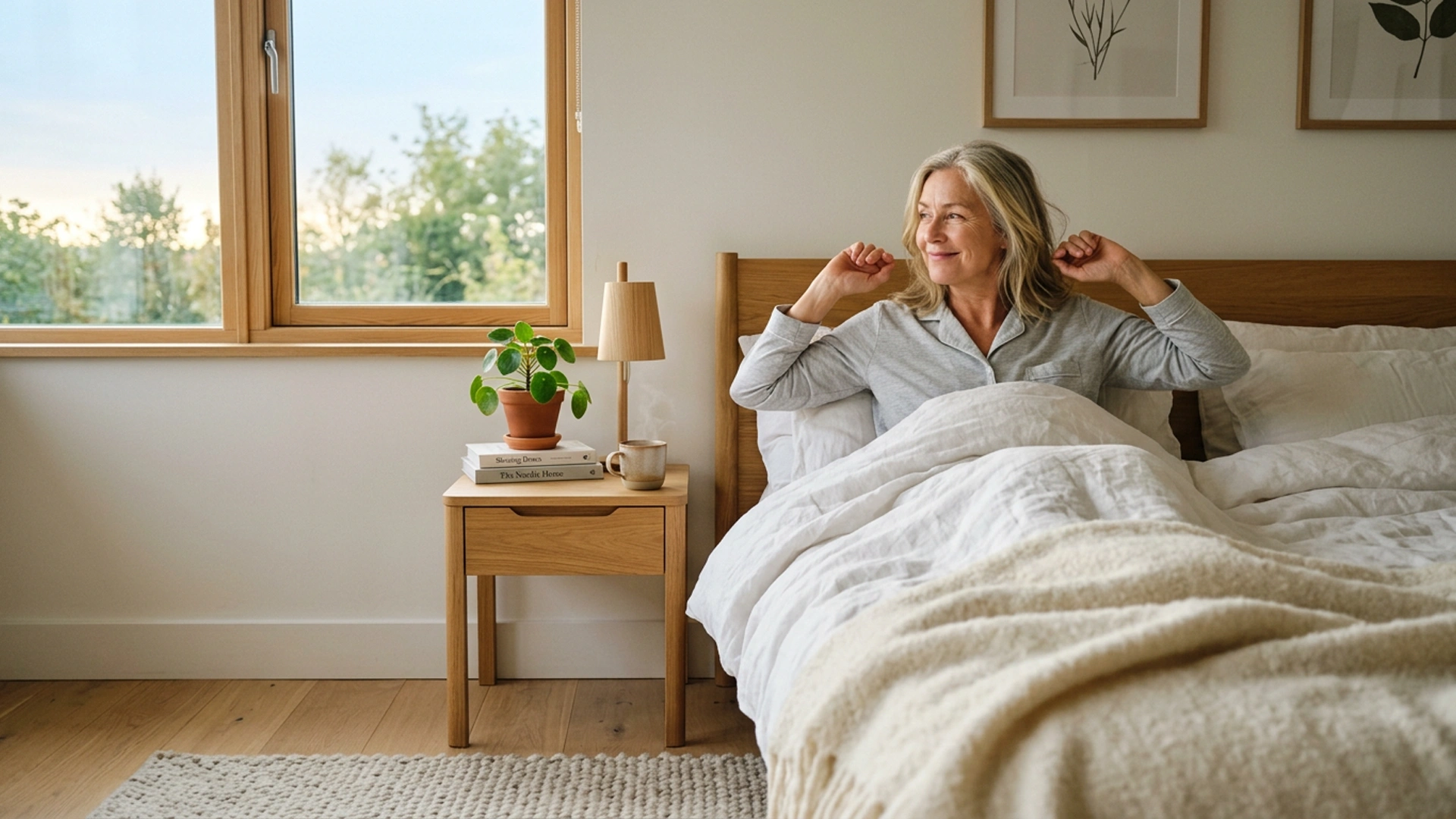
I sleep better. I have more energy on the weekends. I'm not starting Saturday mornings in a panic.
My husband said one evening, out of nowhere: "You seem less burdened lately." That's the word.
Burdened. I had been carrying something heavy for so long I'd forgotten it was there.
Somewhere in those thirty days of five-minute tasks, I put it down.
If you've spent years doing exactly what you're supposed to do, clearing out, reorganizing, starting fresh, and the mess always comes back: it was never about the method. It was about the pattern underneath it that no method was touching.
This one touches it.

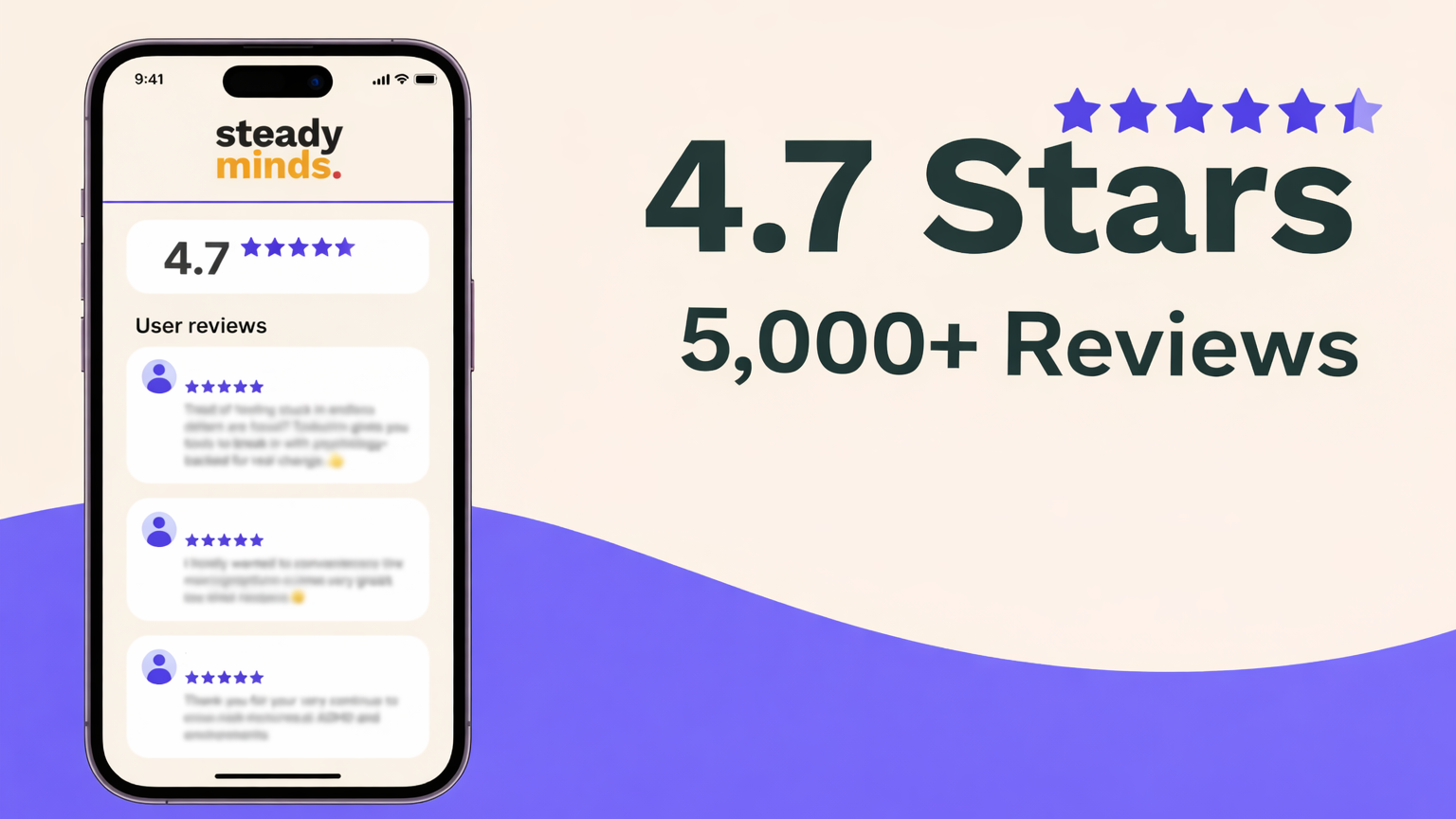
Julia S

Reviewed in the United States
Verified Purchase
"I usually give up on things pretty easily, but this time I stuck with it. And I'm so glad I did! This plan helped me get promoted at work."

Dan M
Reviewed in the United States
Verified Purchase
"It's so much more than just a plan. The plan is great, but it's the reassurance, support and community that has helped me take my career to the next level."
Silvia M
Reviewed in the United States
Verified Purchase
"It only takes 5-10 minutes each day, but it makes me feel so much more productive."
Why Most People Haven't Heard About This
The app comes directly from the research team, no middlemen, no corporate investors.
Think about what most people spend trying to fix this problem:
Traditional therapy: $200+ per session, weekly commitments for months.
Organization courses: $497, temporary results.
Professional organizers: one-time fixes that don't rewire the patterns.
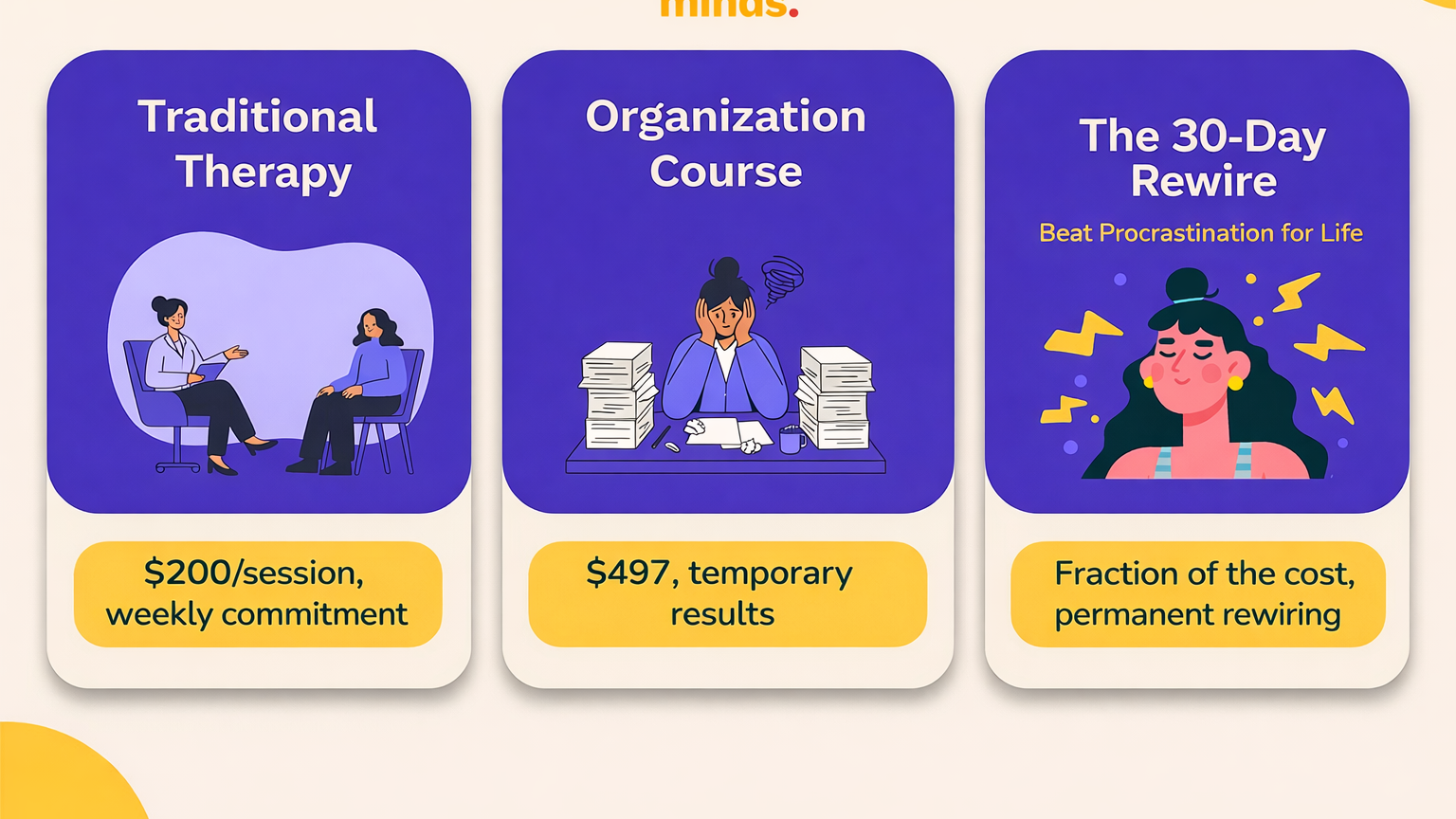
SteadyMinds costs a fraction of those options.
And unlike one-time fixes that fade, this actually retrains your brain permanently.
Right now, they're running a major discount for new users.
But when they hit capacity, the discount ends.
This 2-Minute Quiz Reveals YOUR Specific Procrastination Pattern (And The Exact Fix For It)
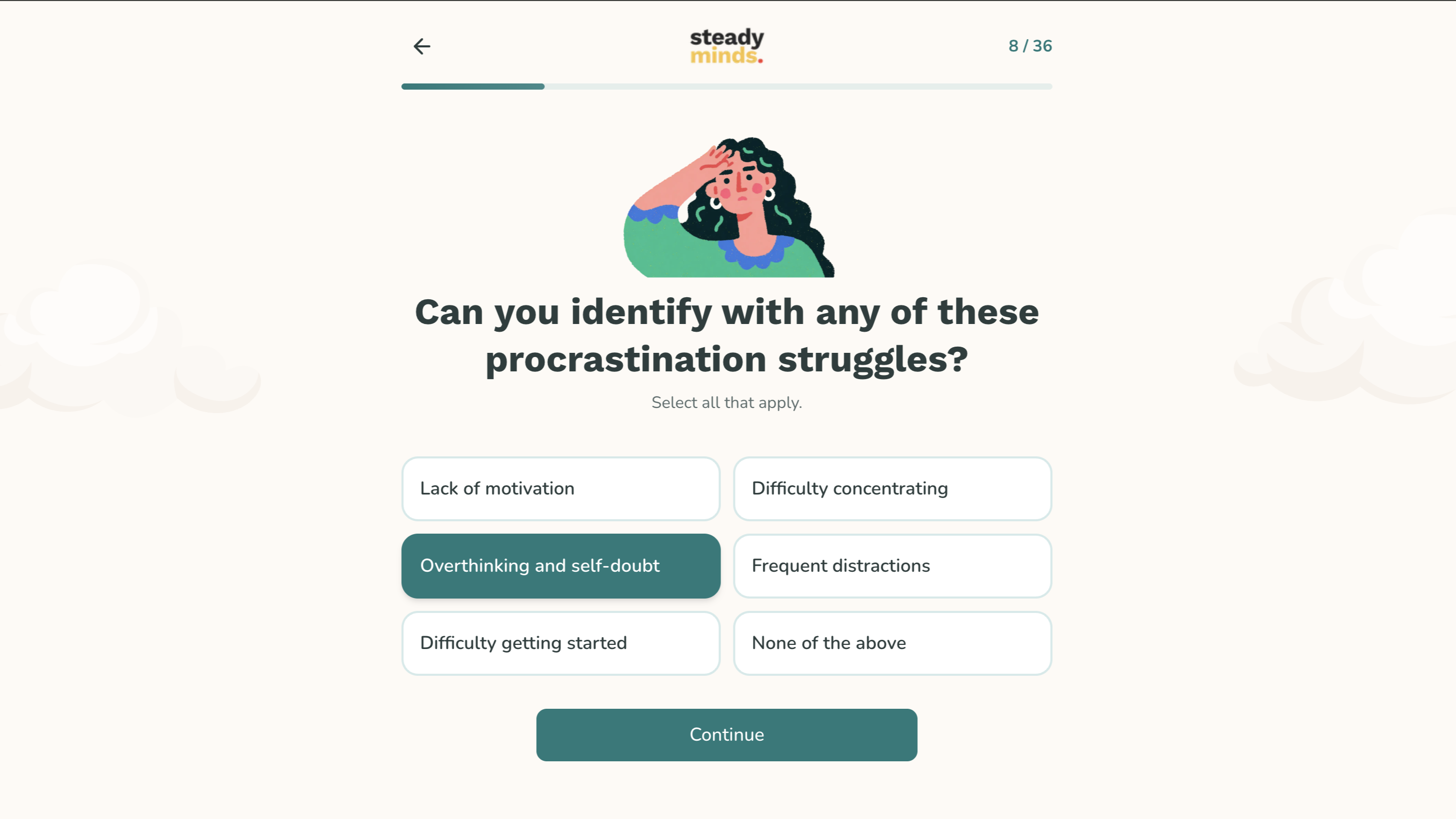
Click the button below.
The quiz will ask you a few simple questions about how you handle tasks and clutter.
Then it identifies your specific procrastination type.
(Most people tell me this part alone was eye-opening. Finally understanding WHY they'd struggled for so long.)
After that, you get immediate access to the app with your personalized program.
The one designed specifically for how your brain is wired.
5 minutes a day. That's it.
Within 30 days, you'll be part of the 81% who are completely procrastination-free.
No willpower required. No massive lifestyle overhaul.
Just new neural pathways that actually stick.
TAKE THE FREE QUIZ - DISCOVER YOUR PROCRASTINATION TYPE