
Stanford Researchers Identified The "Protection Loop" In 76% Of Self-Described Procrastinators — And An App Built On Their Research Is Breaking It In 30 Days.
I was 28 when I finally said it out loud.
Sitting across from a therapist I'd just met, I felt my face get hot.
"I think I'm just… lazy."
She didn't nod. Didn't write anything down. Just tilted her head and waited.
"I mean it," I pushed. "I have ideas. I have plans. I have three unfinished projects on my laptop right now. I just… don't do them. For weeks. Sometimes months. And I hate myself for it."
She waited a beat longer.
Then she said eight words that cracked something open I didn't know was sealed shut.
"You're not lazy. You're avoiding. There's a difference."
This wasn't always how I saw myself, but I'd carried this label since I was nine years old.
My fourth-grade teacher wrote it on a report card. "Bright student. Lazy worker."
My mom taped that report card to the fridge. I think she meant it as motivation — let's prove her wrong. But I was nine. I didn't read it as a challenge. I read it as a diagnosis.
And once a kid decides she's "the lazy one," she spends the next two decades collecting evidence.
Missed deadline in high school? Lazy.
Dropped out of a grad program I'd fought to get into? Lazy.
Three-month gap on my LinkedIn where I told everyone I was "freelancing" but mostly rewatched sitcoms on my phone? Definitely lazy.
By 28, I'd built an entire identity around being the girl who could have been something — if only she weren't so lazy.
I'd tried everything to fix it. Productivity planners. Pomodoro timers. The $200 hardcover habit tracker everyone on TikTok swore by. Cold showers. 5 AM wake-ups. Habit stacks. A dopamine detox that lasted four days.
Every method worked for about a week. Then the "laziness" came roaring back.
I thought there was something wrong with me specifically.
As it turns out: there was something wrong, but it wasn't laziness. It was a pattern in my brain that no productivity method on Earth was built to touch.
The Sentence From A Harvard Researcher That Flipped Everything I Believed About Myself
The therapist's name was Dr. Claire Weston. She'd spent fifteen years at Harvard's Behavioral Health Lab before going into private practice.
And she explained something that made my jaw drop:
"When we study people who call themselves chronic procrastinators, we don't see a willpower problem. We don't see a character problem. We see a very specific neural pattern we call the Protection Loop."
She pulled up a study on her tablet.
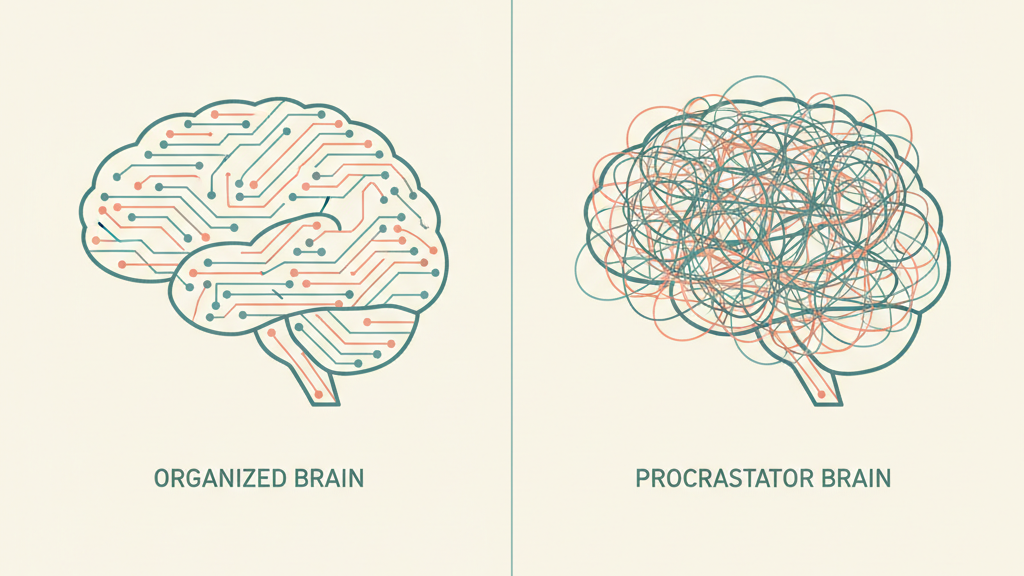
The non-procrastinator's brain, when facing a task: clean, sequential neural pathways firing in order. Think → decide → begin.
The chronic procrastinator's brain, facing the same task?
Dozens of pathways lighting up at once. A tangle. The brain racing through every possible outcome — what if I fail, what if I succeed, what if it's not good enough, what if it IS good enough and then I have to do it again forever — until it overloads and shuts down.
"The person walks away from the task," Dr. Weston said. "And every time they walk away, the loop gets a little stronger."
She looked at me.
"It's not laziness. It's your nervous system protecting you from a feeling it doesn't want you to have. The task isn't the problem. The feeling underneath the task is the problem. And you've been trying to solve it with discipline — which is like trying to put out a kitchen fire with a spreadsheet."
I didn't say anything. I couldn't.
Because for the first time in twenty years, something made sense.
Stanford Researchers Identified The "Protection Loop" In 76% Of Self-Described Procrastinators
When I got home that night, I went down a research rabbit hole.
Dr. Weston's "Protection Loop" wasn't her personal theory. It was based on a decade of research out of Stanford's Behavioral Design Lab, led by Dr. Amanda Cho.
Dr. Cho's team had studied over 147,000 adults who identified as chronic procrastinators. What they found was unlike anything in the traditional productivity literature:
76% of participants showed the exact same neural pattern. Not a personality flaw. Not a motivation deficit. A protection response — the brain treating the task as an emotional threat and shutting down to keep the person "safe."
"You cannot willpower your way out of a protection response," Dr. Cho wrote in her published findings. "The harder you push, the harder the brain protects. This is why discipline-based approaches fail for this population — they're working against the nervous system, not with it."
What did work, according to her team, was something completely different.
Not therapy. Not planners. Not willpower. Micro-interventions.
Tiny daily exercises — small enough that the brain doesn't register them as "threats" worth protecting against — repeated consistently until a new neural pathway formed.
Not the "clean your desk" kind of small. Something smaller. Something the brain couldn't mount a defense against.
"Your brain learns from completed evidence," Dr. Cho's report explained. "Give it tiny, undeniable evidence of completion, daily, and the Protection Loop starts to dissolve. Not through force. Through repetition of a quieter pattern."
Her research team had spent three years turning the method into an app.
SteadyMinds. A short lesson and one small exercise, every morning. Five to ten minutes.
The research showed 81% of participants were completely procrastination-free within 30 days.
I downloaded it before I went to bed.
Day 1: The Smallest Assignment I've Ever Been Given
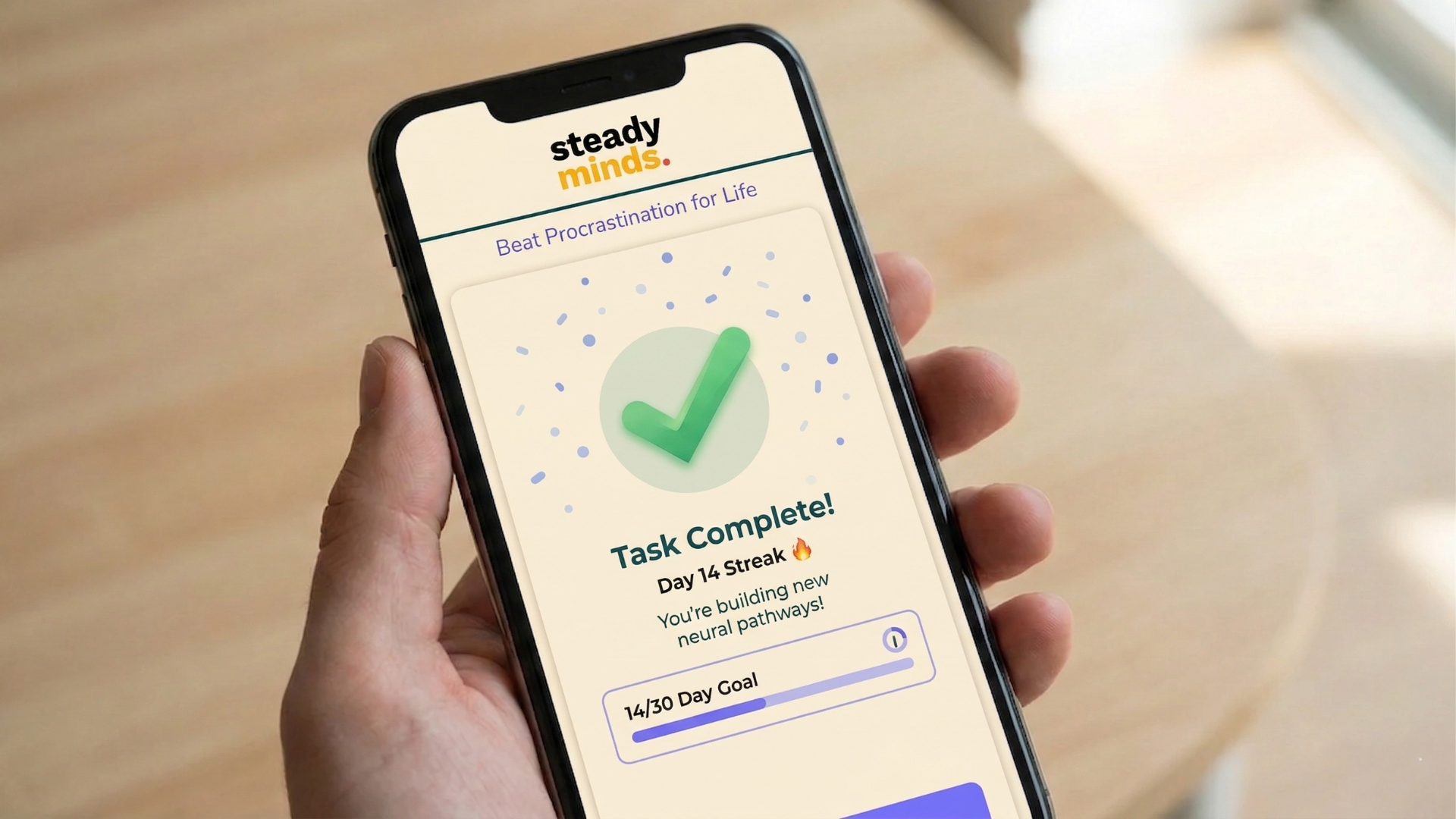
The app asked me three questions.
- When you avoid a task, do you usually feel numb, anxious, or ashamed?
- Do you tend to avoid tasks that are hard — or tasks that matter?
- When you finally do start something, how do you feel during the work?
I answered honestly. Hit submit.
"The Protection Pattern."
The description:
You avoid tasks not because you don't care, but because you care too much. Your brain links performance to identity, so unfinished work feels emotionally safer than imperfect finished work. You are not lazy. You are protecting a version of yourself you're afraid to lose.
I read it three times.
Then the app gave me my first exercise:
"Before starting any task tomorrow morning, ask yourself one question: 'What feeling am I afraid will come up if I do this?' Don't try to fix it. Just name it."
That was it. One question. No task list. No planner. No timer.
I almost closed the app, annoyed. I'd paid good money for what felt like a journaling prompt.
But the lesson explained the point:
"The Protection Loop only works when the feeling is hidden. Naming it, out loud or on paper, reduces the protection response by up to 40% in clinical studies. The brain cannot protect you from something you have already looked at directly."
Day 2.
I opened my laptop to work on a report I'd been avoiding for nine days.
Before I touched the keyboard, I asked the question.
What feeling am I afraid will come up if I do this?
The answer came immediately: I'm afraid I'll write something mediocre and realize I've been overestimating myself this whole time.
There it was. Not laziness. Fear of being ordinary.
I didn't fix the fear. I didn't even try. I just saw it.
And then — quietly, strangely — I opened the document and started typing.
Not because the fear was gone. Because the fear wasn't hidden anymore. I could see it. And once I could see it, it stopped running the show.
I finished the report in 43 minutes.
I'd spent nine days not-doing a task that took 43 minutes.
Week 2: My Boyfriend Asked If I'd Started Therapy

The exercises kept coming. Each one small.
"Today, do one task badly on purpose. The goal is not quality. The goal is completion."
"Today, name the feeling underneath your avoidance in under 10 seconds. Don't explain it. Just label it."
"Today, when you catch yourself checking your phone to avoid something, set the phone down and ask: what am I protecting myself from right now?"
None of them felt like productivity advice. They felt more like… little keys. Each one unlocking a door I hadn't known was locked.
By day 10, I was moving through tasks differently.
Not faster, exactly. Quieter. The constant background noise of I should be doing something started fading.
My boyfriend noticed before I did.
"Did you start therapy again?"
I laughed. "No. Why?"
"You just seem… less haunted. Lately."
Haunted. I hadn't realized how haunted I'd looked until someone used the word out loud.
Week 4: The Word "Lazy" Stopped Making Sense

Something strange happened around day 25.
I was at a birthday dinner. A friend of a friend was complaining about her "laziness" — the same way I used to complain about mine, with that mixture of self-deprecation and real shame.
And I opened my mouth to agree, out of habit.
And I couldn't.
The word didn't fit anymore. It didn't fit her — I could see the anxious way she held her wine glass, the way her eyes flicked to her phone every few minutes. That wasn't laziness. That was a person running from something.
And it didn't fit me either.
For twenty years, I'd been walking around carrying a word that was never the right word.
"Lazy" had been the story. The real story was: I was a person who cared so much about being good at things that I'd rather not try than try and discover I wasn't special. My brain had built a protection system to keep me from that feeling. And every productivity method I'd ever bought had been trying to blow up the protection system from the outside — which just made the system stronger.
The app wasn't blowing anything up.
It was teaching my brain, five minutes at a time, that the feelings I was protecting myself from… weren't actually going to destroy me.
I could feel mediocre and survive.
I could feel exposed and survive.
I could feel ordinary and survive.
And once my brain learned that, it stopped protecting me from tasks. Because tasks aren't dangerous. Only the feelings underneath them feel dangerous — and only when you haven't looked at them directly.
Why Productivity Advice Keeps Failing You
Every productivity method focuses on the behavior.
Wake up earlier. Work in 90-minute blocks. Delete your phone apps. Stack your habits. Drink more water.
But behavior change is the symptom, not the cause.
The cause is the Protection Loop — the feeling your brain is hiding you from.
Until you name that feeling, every productivity method is just another thing for your brain to avoid. Another planner to buy, another app to download, another system to abandon in two weeks.
CBT-based micro-interventions work differently.
They don't ask you to push harder. They ask you to look underneath.
Five minutes a day. Every day. Until the feelings you've been avoiding stop having the power to run your life.
Within 30 days, 81% of users are no longer stuck in the Protection Loop.

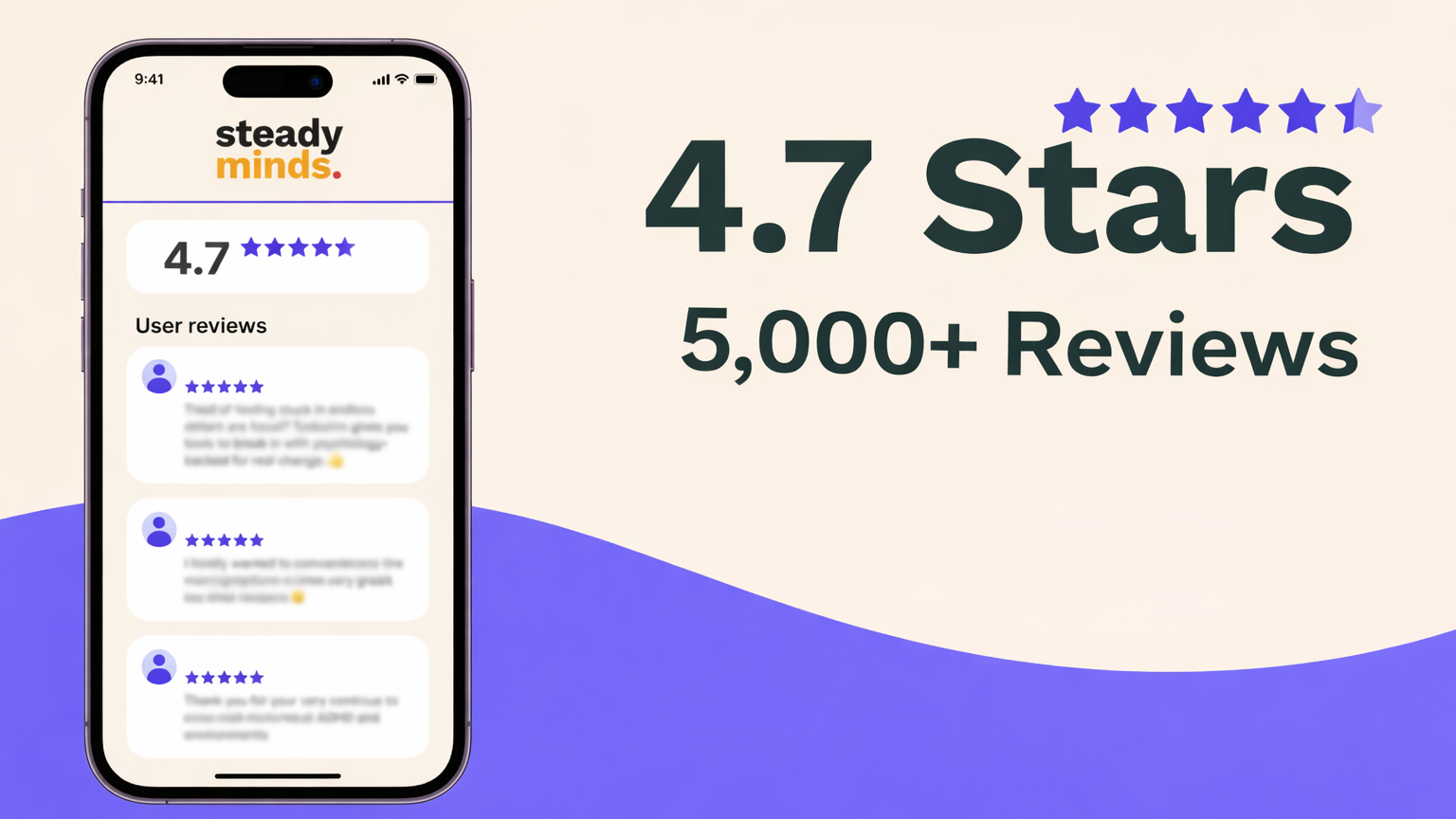
Julia S

Reviewed in the United States
Verified Purchase
"I usually give up on things pretty easily, but this time I stuck with it. And I'm so glad I did! This plan helped me get promoted at work."

Dan M
Reviewed in the United States
Verified Purchase
"It's so much more than just a plan. The plan is great, but it's the reassurance, support and community that has helped me take my career to the next level."
Silvia M
Reviewed in the United States
Verified Purchase
"It only takes 5-10 minutes each day, but it makes me feel so much more productive."
Why Most People Haven't Heard About This
SteadyMinds comes directly from the research team — no middlemen, no corporate investors.
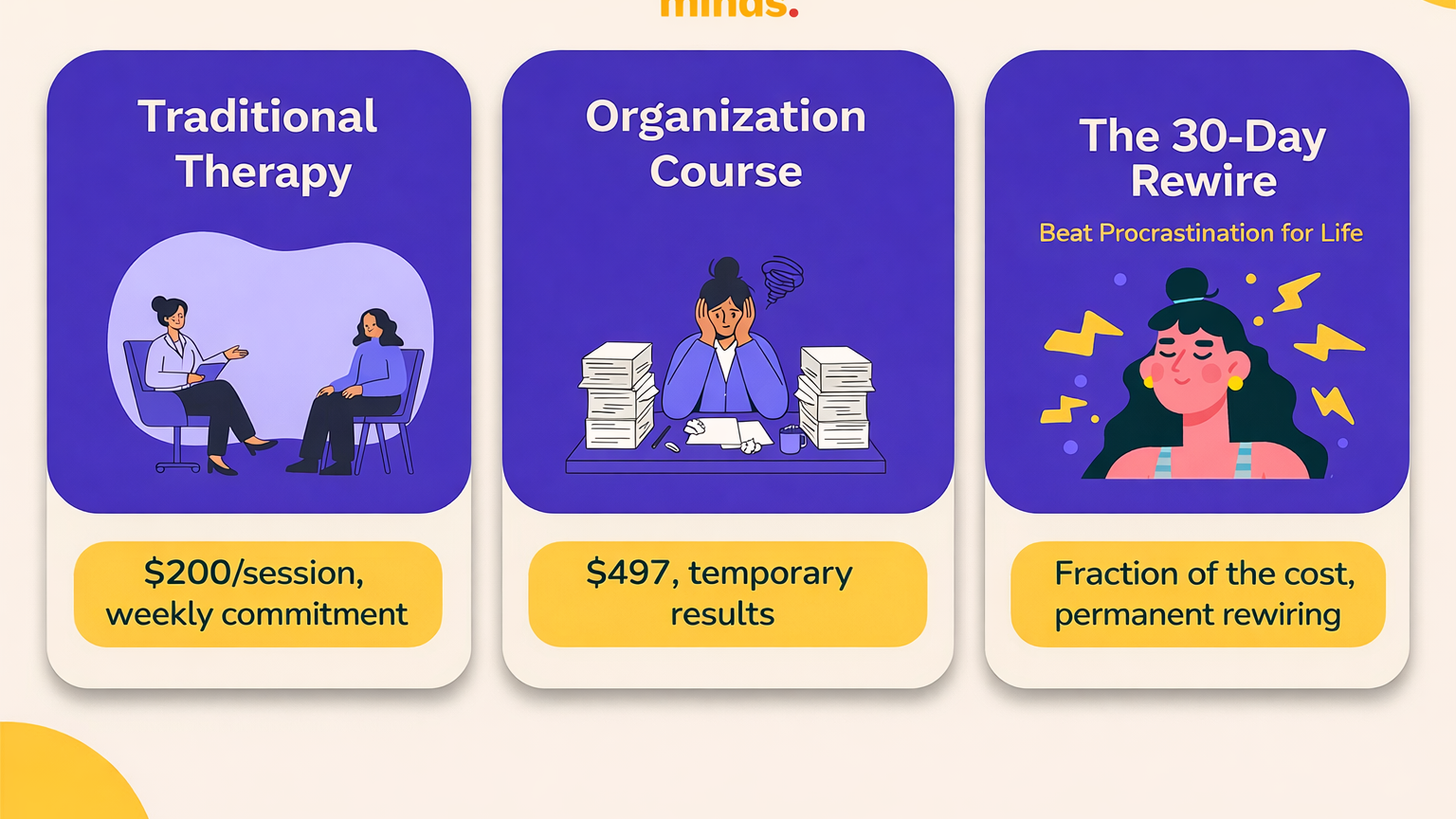
Think about what most people spend trying to fix this problem:
Traditional therapy: $200+ per session, weekly commitments for months.
Productivity courses: $497, results that fade in three weeks.
Coaches and planners: Temporary fixes that don't touch the neural pattern underneath.
SteadyMinds costs a fraction of those options. And unlike one-time fixes that fade, it actually rewires the pattern permanently.
Right now, they're running a major discount for new users.
But when they hit capacity, the discount ends.
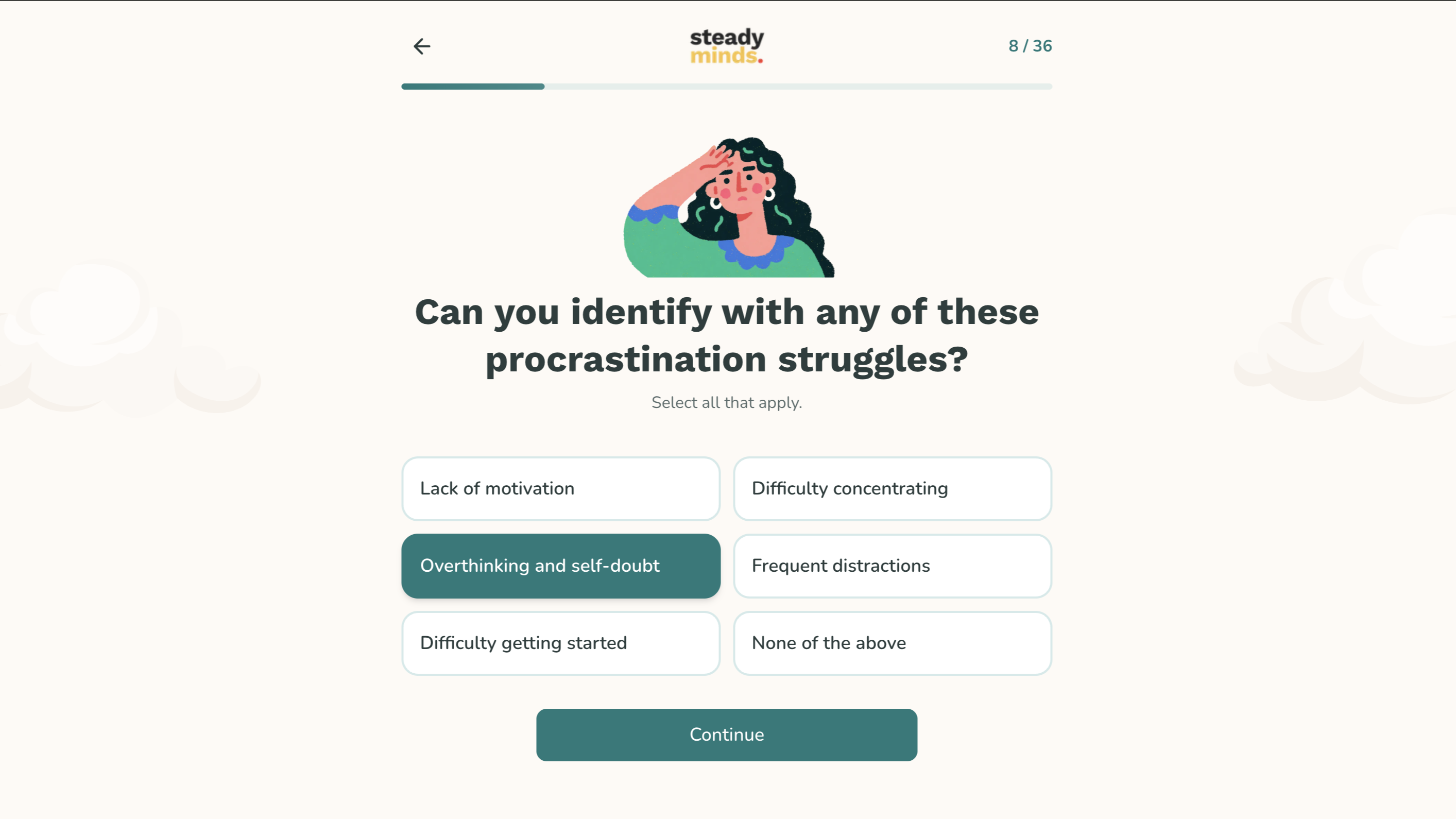
This 2-Minute Quiz Reveals YOUR Specific Procrastination Pattern (And The Exact Fix For It)
Click the button below.
The quiz will ask you a few simple questions about how you handle tasks and feelings of overwhelm.
Then it identifies your specific procrastination type.
(Most people tell me this part alone was eye-opening. Finally understanding WHY they'd struggled for so long.)
After that, you get immediate access to the app with your personalized program — the one designed specifically for how your brain is wired.
5 minutes a day. That's it.
Within 30 days, you'll be part of the 81% who are no longer stuck in the Protection Loop.
No willpower required. No massive lifestyle overhaul.
Just new neural pathways that actually hold.
TAKE THE FREE QUIZ - DISCOVER YOUR PROCRASTINATION PATTERN